

My grandfather saw the mushroom cloud with his own eyes. In 1945, he was serving in the Royal Navy in the South Pacific, and within months of the detonation he was in a landing party that walked through the devastated streets of Hiroshima. I suspect he saw far more than he ever spoke about later. He did bring something back with him, though: a swirling, glassy hunk of matter that he picked up in the ruins.
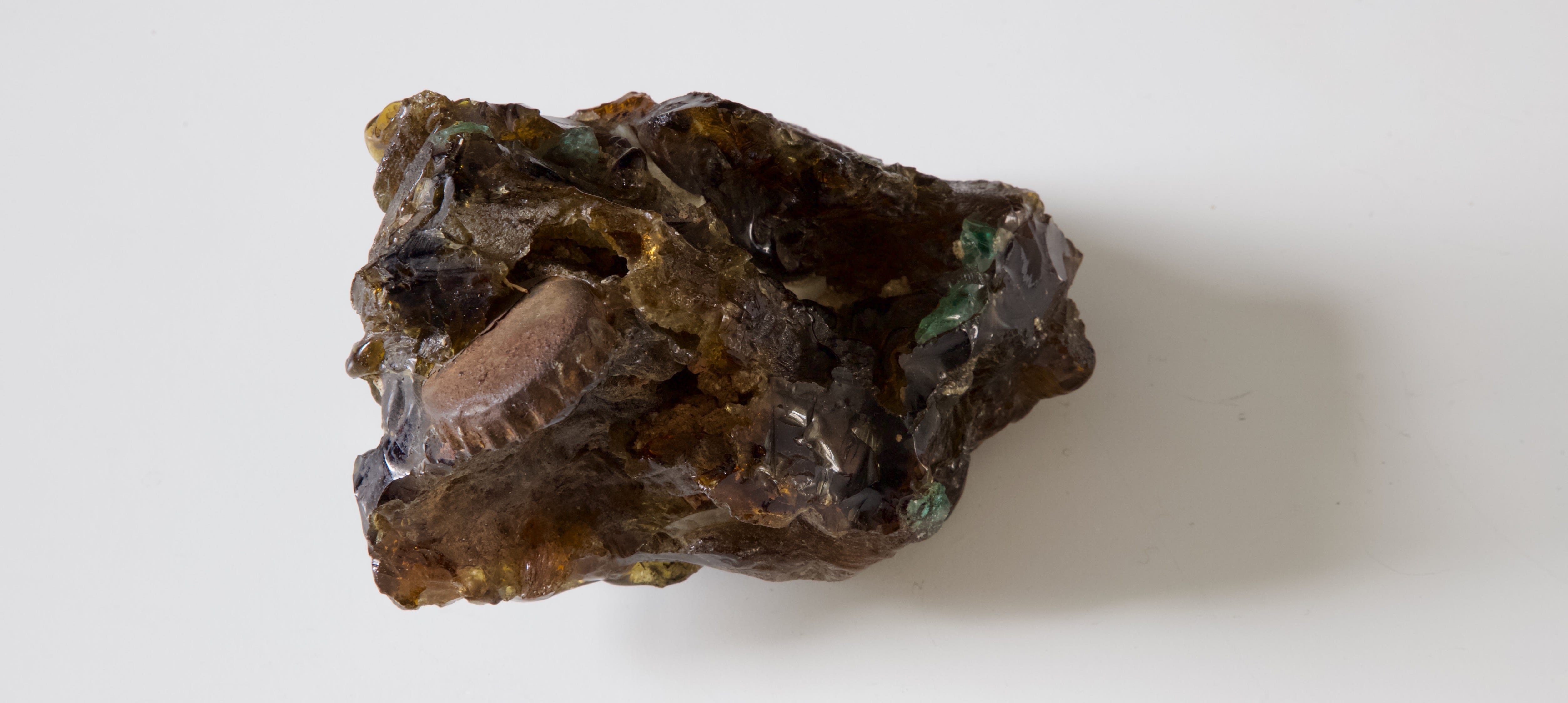
Hiroshimaite is the name given to the glassy fallout material formed by the extreme heat and destructive forces of the Hiroshima atomic bombing of 6 August 1945. Temperatures of at least 1,800 °C caused materials such as concrete, bricks, roof tiles, soil, and metals to melt together, producing complex silicate glasses. The term hiroshimaite came into use after researchers studying unusual glass particles near Hiroshima argued that the material was compositionally more diverse than the so-called trinitite retrieved from the Trinity test site in New Mexico, and therefore warranted its own designation.
I have been fascinated by this object – which sat on the sill in my grandfather’s study – for as long as I can remember. A chaotic mass of malformed matter; crystallised corruption; a city’s equivalent to a tumour, perhaps.
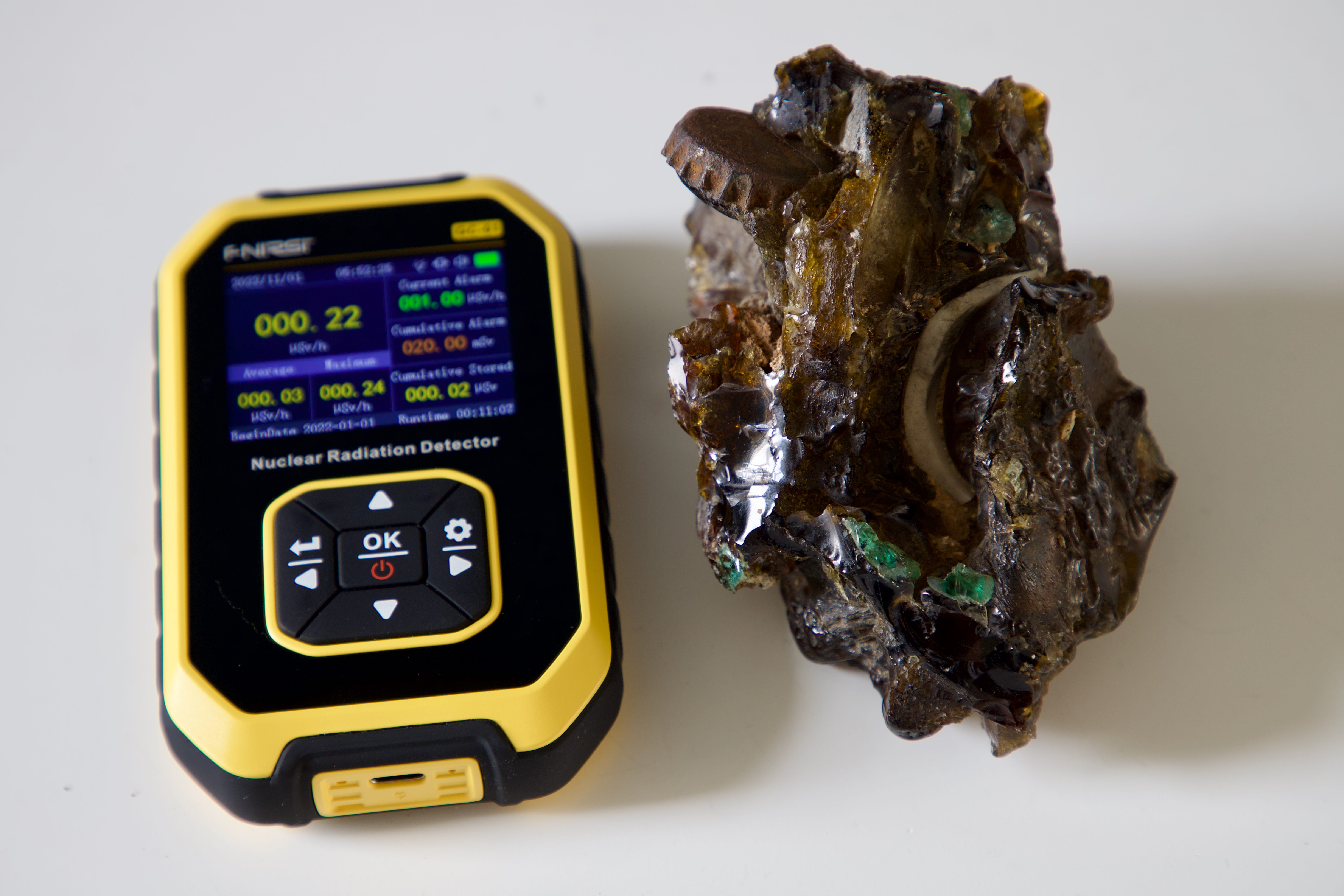
In recent years, my radiation meter has been gathering dust. But after my grandfather’s recent passing, I had the opportunity to take some readings from his hiroshimaite artefact. I took the measurements with a handheld radiation survey meter, at the bottom of the garden, away from any likely sources of interference and in a place where the background radiation level showed around 0.08 μSv/h (that is, microsieverts per hour): comfortably within the typical UK range of about 0.05–0.15 μSv/h.
In this context, a close-range reading of the artefact showed a maximum of 0.24 μSv/h. That’s around three times background, and a little above the upper end of the expected ambient range.
So what causes that? The best way to find out would be to chip off a tiny piece of the artefact and submit it for gamma spectroscopy under laboratory conditions. These are methods beyond the means of me and my handheld survey meter. However, laboratory analyses of similar glass artefacts have typically found that the observed radioactivity comes from trace amounts of fission products and neutron-activation products fixed in the glass during cooling. Tiny active particles became stuck in the molten matter at the time of the explosion, like flies in amber.
After 80 years, the short-lived isotopes will have mostly decayed away. Any traces now – such as the abnormal readings I was able to observe – are likely to come from longer-lived contributors such as:
Cesium‑137 (half‑life ~30 years)
Americium‑241 (from plutonium‑241 decay, half‑life ~432 years)
Europium isotopes such as Eu‑152 and Eu‑154 (neutron activation products)
Barium‑133 (half-life ~10.5 years)
and potentially, traces also of cobalt‑60.
Nowadays, these readings – while unusual enough to be interesting – are far below what could be considered a dangerous level of radiation. I am talking here in microsieverts; 1,000 of those make a millisievert, and 1,000 millisieverts make a sievert. During the split second in 1945 when the bomb detonated, citizens of Hiroshima living within a kilometre of ground zero received acute doses as high as 4.2 sieverts; vastly more radiation than you’d get from an hour spent with this hunk of hiroshimaite today.
Regulatory commissions often speak in terms of the LD-50/30: the dose of radiation expected to kill 50% of an exposed population within 30 days. This figure is often placed at around 4-5 sieverts. Hiroshima saw that kind of exposure, as did Chornobyl: where liquidators working in the immediate aftermath could receive fatal doses as high as 6 sieverts (while others may have received closer to 1 sievert, causing nausea and radiation sickness, but not necessarily proving fatal). In the days after the Chornobyl disaster, the maximum levels detected in the city of Pripyat were closer to 6.5 millisieverts per hour – around a thousandth of the total dose that killed some of the first responders at the power plant.
The typical background level encountered in the Chornobyl Zone today is often around 0.1 microsieverts per hour – about the same as an ordinary English garden. As I would tell tourists I guided around the Zone: Chornobyl is not a radioactive place. Better to think of it instead as a containment area for a number of incredibly tiny, still-radioactive particles. (In the same way that a safari park is not an inherently dangerous place to be, so long as you keep a distance between yourself and the lions.)
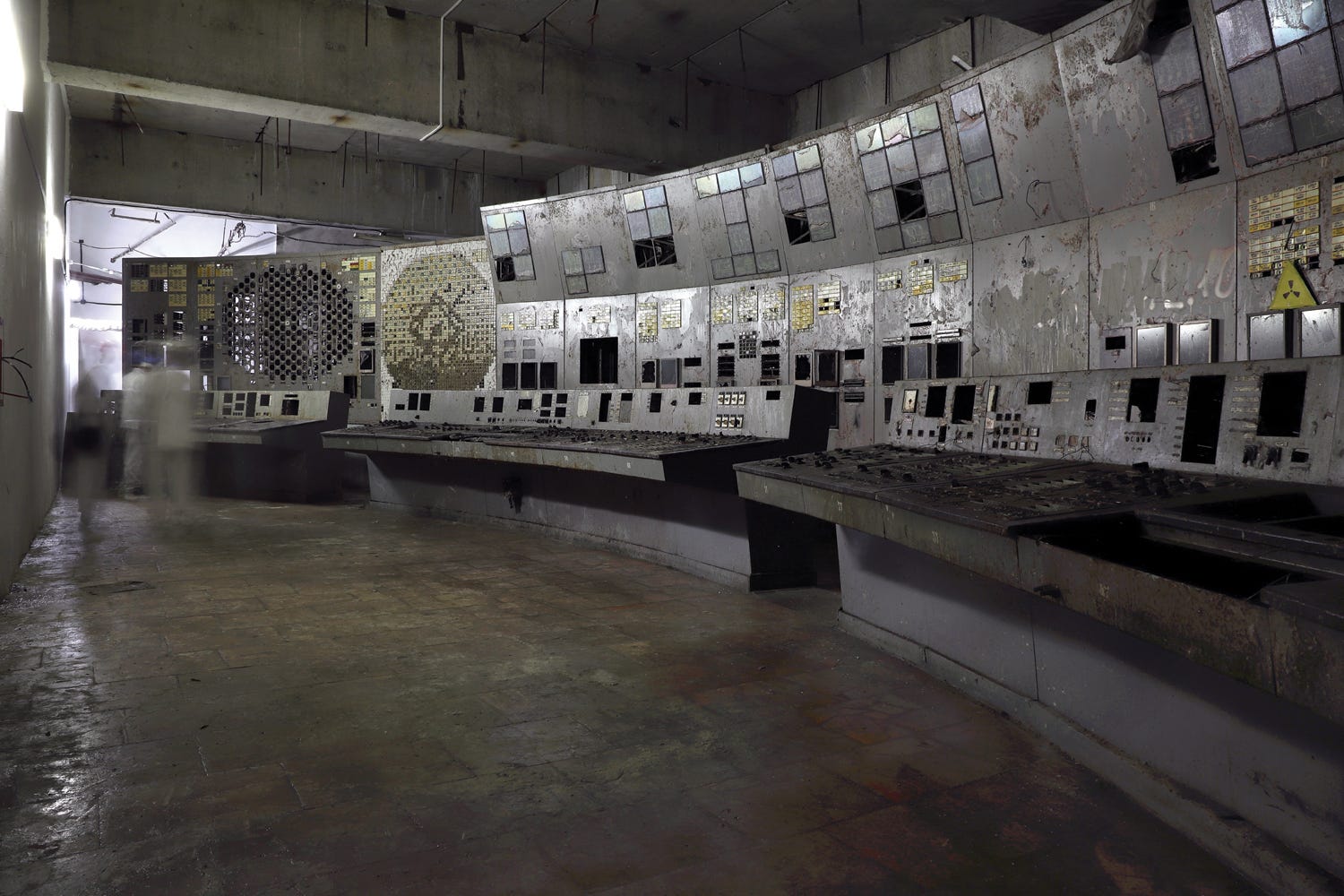
Over the last decade, I spent a total of roughly three months inside the Zone. I took a reading of 40 μSv/h inside the control room for Reactor 4 – the room where the disastrous error was made – and I measured 60–70 μSv/h under the New Safe Confinement structure that now contains the destroyed reactor hall. Those are notably high readings compared with background, but even an hour there may give you just a hundred-thousandth of the dose some liquidators received during the clean-up.
The highest reading I ever saw in the Zone was a trace of around 10 mSv/h, measured in the Red Forest. That is rare – a number like that could be caused by what they call a fuel flea, a microscopic scrap of the original power plant fuel that has remained at large through four subsequent decades of clean-up and management. Alternatively, it is possible the meter malfunctioned. You will forgive me that I didn’t go digging around in the undergrowth to better identify the source…
In 2019, I had a bit of a health scare. Nothing related to radiation, I hasten to add, and all clear in the end, though part of the process involved having a full-body CT scan. At a one-off dose of around 10 millisieverts, a typical medical CT scan is the radiation-exposure equivalent of sitting for an hour on top of the nastiest, dirtiest thing I ever found in Chornobyl. And after a decade of getting to know the Zone, my total cumulative exposure from that place is still a good deal less than I received in one routine hospital visit back home.
In cases such as Hiroshima and Chornobyl, the fear of danger may sometimes last longer than the actual danger itself. In my first draft of this essay, I was planning to explore a whole other section about nuclear taboos, and the social stigmatisation of post-exposure populations – and their descendants – though ultimately I think that is a large enough conversation to merit its own article another day.
However, there is a trace of these things in all of us now, however small, which is perhaps best exemplified by the concept of low-background steel: the name given to steel produced before the detonation of the first nuclear bombs. Steelmaking uses oxygen, but our atmosphere was contaminated by radionuclides released by the explosions in the 1940s and onward at Alamogordo, Novaya Zemlya, Hiroshima, Nagasaki... For the creation of high-precision radiation meters – particle detectors and whole-body counters – it becomes necessary to use metals that did not witness these events. They require low-background, or pre-nuclear, steel: untainted matter that can be harvested from sources such as pre-war shipwrecks and other steel artefacts of the naive era.
Those contaminants end up in us too, so that the human body carries a trace of its own sin: microplastics and radionuclides lurk within us like Dorian Gray’s portrait in the attic.
NB: The figures here draw on my own measurements and on published material from sources such as the IAEA, the World Nuclear Association, the CDC, and Chornobyl NPP documentation. Any comparison between an acute dose and an hourly dose can only ever be approximate, since such figures depend on time, distance, shielding, instrument response, and measurement conditions.
Another really fascinating insight into the hidden worlds that few of us will ever see, thanks
Beautifully written essay, very though provoking.... thank you